Grazing on Public Lands: Informational Tidbits About the Bureau of Land Management and the United States Forest Service Grazing Programs
by Kendra Young
Efficiently maximizing land usage, property ownership, and thus understanding governing resource regulations are a common conundrum among many landowners. Especially those who ranch or graze livestock. In the western United States, landownership is a many-splendored thing. There are public lands and private lands; state lands and federal lands; National Forests, National Parks, and National Wildlife Refuges. The list of land ownership possibilities is almost endless. Through agencies such as the Bureau of Land Management (BLM), the Fish and Wildlife Service (FWS), the National Park Service (NPS), the Forest Service (FS), and the Department of Defense (excluding the U.S. Army Corps of Engineers), the Federal Government owns and/or manages roughly 615.3 million acres or 27% of the U.S. land base (Federal Land Ownership: Overview and Data). Each ownership entity has their own stated vision and mission for the landscape, as well as rules and regulations to govern the lands and all activities on them.
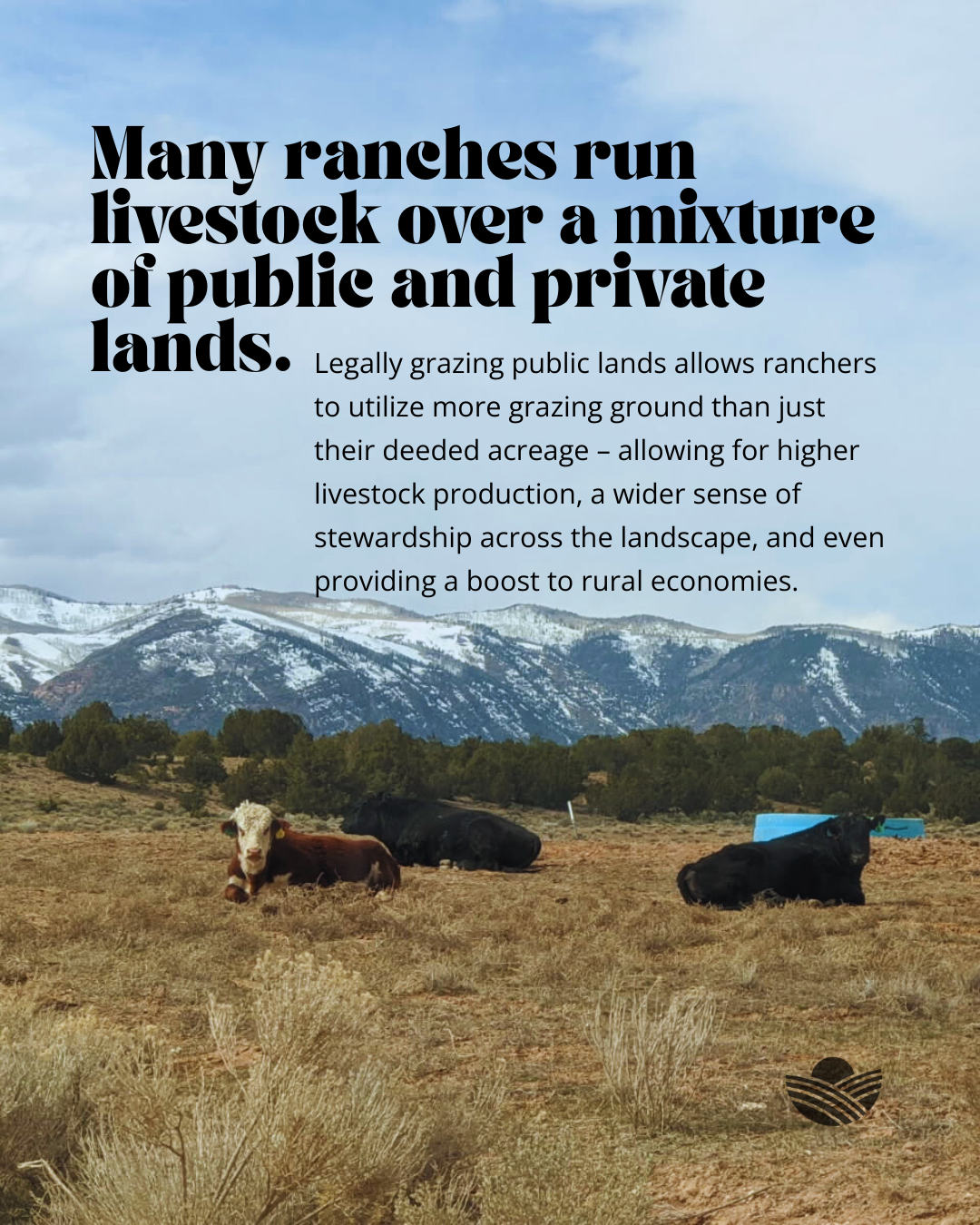
Many ranches in the Western United States run livestock over a mixture of public and private lands. Legally grazing public lands allows ranchers to utilize more grazing ground than just their deeded acreage – allowing for higher livestock production, a wider sense of stewardship across the landscape, and even providing a boost to rural economies. Grazing allotments are a coveted opportunity among ranchers. There are a limited number of allotments available. Most allotments are tied to generational ranches and passed down along with the operation. Many Federal Offices also have a waiting list of producers who would like to obtain a federal grazing lease if the opportunity arose. While there are a limited number of grazing allotments available, it is important to understand the differences between each type, and which could fit best within your operation.
The United States Department of Interior’s Bureau of Land Management and the United States Department of Agriculture’s Forest Service are two of the most recognizable land management agencies in the United States. If a rancher is the recognized permittee or holds the grazing lease, both entities allow livestock grazing across their landscapes for a nominal fee. This grazing fee can change annually based on a multitude of factors. This Federal Grazing Fee Year is March 1, 2025 through February 28, 2026. The 2025 Federal Grazing Fee is $1.35 per animal unit month (AUM), (2025 Grazing Fee, Surcharge Rates, and Penalty for Unauthorized Grazing Use Rates). The fees associated with grazing on public lands are usually very low compared to private grazing leases, thus allowing ranchers to graze animals on open rangelands with minimal practical costs incurred by the operation.
There are several stipulations to applying for and operating on a federal grazing allotment. One such requirement is that both the Forest Service and the Bureau of Land Management require the permittee to own a “base” property. Base property is private land the permittee owns, that the livestock can go to if something like a major natural disaster happens, and the animals can’t be on federal lands. This also stipulates that a ranching operation cannot graze 100% of the time on federal lands only. Forest Service base property requirements include: “the applicant must own base property to be permitted, the base property is land and improvements owned and used by the permittee for a farm or ranch operation and specifically designated by him to qualify for a term grazing permit,” (FS and BLM Grazing Administration Requirements and Processes). The Bureau of Land Management’s base property requirements include: “BLM requires an applicant to own or control base property. The base property is land capable of serving as a base of operations for livestock use. For the desert southwest, base property can be water,” (FS and BLM Grazing Administration Requirements and Processes).
Livestock ownership is another stipulation in the federal grazing permitting process. To qualify for a Forest Service grazing permit, an applicant must own the livestock to be permitted; whereas the BLM does not require ownership of the livestock but does require proof of control (such as a lease), and a surcharge is added to the grazing fee for livestock grazed but not owned by the permittee (FS and BLM Grazing Administration Requirements and Processes).
The Bureau of Land Management manages livestock grazing on approximately 155 million acres of public lands. Most of these allotments are grazed by sheep or cattle. However, as of January 2025, the Bureau of Land Management oversees forty-one bison grazing permits and eight reindeer permits (The Bureau of Land Management’s Grazing Program). The Bureau of Land Management administers nearly 18,000 permits and leases, that cover over 21,000 allotments for at least part of the year when grazing occurs (Livestock Grazing on Public Lands). Bureau of Land Management grazing permits and leases are typically for a ten-year period and are renewable if the Bureau of Land Management determines that the conditions of the expiring lease and/ or permit are being met (Livestock Grazing on Public Lands).
Forest Service grazing permits have several similarities to Bureau of Land Management grazing permits. The Forest Service System includes both National Forests and National Grasslands. The Forest Service administers approximately 191 million acres of National Forest System lands; about half of that acreage (96 million acres) is rangelands (About Rangeland Management). The Forest Service has a history entwined with the West. In the 1800s, the building of large cattle and sheep herds, livestock empires, wrought the West with over-crowding, over-grazing, and over-stocked landscapes. In the early 1900s, Congress designated the Forest Service as the pioneer grazing control agency; by 1906-07, the Forest Service had established a system of range regulations – permits, herd limits, grazing seasons, allotments, and rental fees (About Rangeland Management - History). Whereas the Forest Service has evolved over time, they are still committed to maintaining and improving rangeland health, managing vegetation resources across the range landscape for multiple uses, and sustaining grazing and browsing opportunities (About Rangeland Management – Current Direction).
Livestock grazing on public lands generally implies a Bureau of Land Management or Forest Service allotment, but there are so many other entities that own lands and work for the betterment of “multi-use” by incorporating livestock into the system. Each organization fits a different niche in the landscape world and works towards the betterment of the ecosystem for all. Integrating livestock into the system is just one facet of a multi-use approach. For more information specific to your region or its land management agencies– contact your local BLM Office, the Forest Service Office, or even State Lands officials.
Resources:
1. Federal Land Ownership: Overview and Data (Congress.gov) https://www.congress.gov/crs-product/R42346
2. 2025 Grazing Fee, Surcharge Rates, and Penalty for Unauthorized Use Rates (BLM.gov) https://www.blm.gov/policy/im2025-019#:~:text=The%20fee%20for%20livestock%20grazing,animal%20unit%20month%20(AUM)
3. Forest Service and Bureau of Land Management: Grazing Administration Requirements and Processes (fs.usda.gov) https://www.fs.usda.gov/rangeland-management/documents/grazing/BLMGrazingAdministrationRequirementsProcesses201708.pdf
4. The Bureau of Land Management’s Grazing Program (BLM.gov) https://www.blm.gov/sites/default/files/docs/2025-02/BLM-Grazing-Program-Infographic.pdf
5. Livestock Grazing on Public Lands (BLM.gov) https://www.blm.gov/programs/natural-resources/rangelands-and-grazing/livestock-grazing
6. About Rangeland Management (fs.uda.gov) https://www.fs.usda.gov/rangeland-management/aboutus/index.shtml