by Tom Shea
Parasites and predators are two of the largest problems that producers face when raising sheep and goats. Predation is often dramatic and traumatic, but parasites are the silent killer. Strong fences, livestock guardian animals, and other precautionary measures can help prevent predation. Compared to predation pressure, parasite issues can be harder to manage.
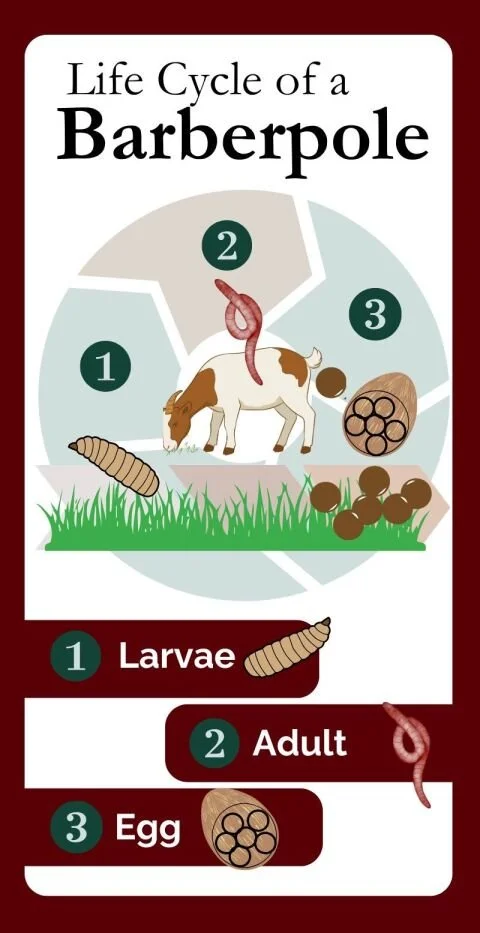
Many parasite treatments are overused, and parasites are becoming resistant. This is leading to more and deadlier parasite issues in small ruminants. People often ask, “How often should I deworm my sheep or goats? Every 3 months, 6 months?” The answer is neither. To slow the development of resistance in Haemonchus contortus (Barber pole worm) to the dewormers we have. We should try to administer dewormers targeting barber pole worms based on FAMACHA© scores (Kumar et al., 2024) to reduce the risk of dewormer resistance. This is combined with the 5-point check, which includes checking the eyes, jaw, body condition score, tail, and nose. Learn more about the Five point check.
FAMACHA© is a diagnostic test that helps small ruminant producers identify animals that require anthelmintic (deworming) treatment and those that do not. The tool is a card that matches eyelid color to anemia levels, an indicator of clinical barber pole worm infection. Its use is limited to the parasites that cause anemia, such as barber pole worm. To receive a FAMACHA card, you must take a FAMACHA certification course, often held by extension services, work with your veterinarian, or contact NatGLC team members Tom Shea and Linda Pechin-Long, both certified instructors, who can point you in the right direction.
Wormx.info is the website of the American Consortium for Small Ruminant Parasite Control. It is a great resource for producers to use to gather information about parasite control in their small ruminant herds and flocks. They provide the most up-to-date information on using dewormers, including combination dewormers to reduce the risk of dewormer resistance. The website puts out newsletters in both English and Spanish. They also provide FAMACHA© training through their online portal. They offer best management practice suggestions, including genetic selection for parasite resistance and pasture management to prevent parasite issues.
One of the most effective ways to prevent parasite issues is good pasture management. Most parasites live on the bottom 2-3 inches of grass blades and stalks (Acharya et al., 2025). Larvae feed on their fat stores until they can infect a new host. Larvae thrive in warm, humid climates, between 65 and 85 degrees Fahrenheit. In these conditions, they can move into the infective stage in as little as 5-7 days. In less favorable conditions, such as 50 degrees, they can take as long as 14 days to reach the infective stage (Acharya et al. Al, 2025). Even with our lowest height recommendations for warm-season grasses like Bermuda grass, we want to leave residuals longer than where the barber pole worm likes to hang out and move our animals more frequently than they reach the infective stage.
Good grazing management also maximizes forage productivity and availability and reduces the likelihood of sheep and goats ingesting parasites. Also leading to healthier animals that are less susceptible to the barber pole worm. This can be accomplished by subdividing pastures with temporary fences, which allows flexibility in your grazing plans. This is often the cheapest and most effective way to combat parasites. In warm, humid climates like the
Southeast, move animals on at least a 4-day rotation, with a minimum 30-35-day rest period, to manage barber pole worms. In cooler climates, you may be able to get away with 5-day rotations with a longer rest period of around 65 days (Acharya et al., 2025). These numbers vary by region and your weather. The barber pole worm can also go dormant during unfavorable conditions, surviving in the non-infective stage and often lasting up to 9 months.
As always, we must find a delicate balance among managing the grass, the soil, and animal health. Grazing plans must remain flexible and adaptable, and every plan is individualized.
If you are interested in learning more about grazing management and our grazing lands, visit our website, grazinglands.org/events, for upcoming events in your region.
Work Cited
Acharya, M., Brown, D., & Burke, J. M. (2025). Grazing management for parasite control in small ruminants.
Kumar, S., Kumar, M., Yadav, D., Kumar, B., & Kumar Singh, R. (2024). Integrated Parasite Management in Small Ruminants. Indian Farmer, 11, 337-338.