by Kendra Young
Conservation grazing is a term to describe using grazing system management to achieve conservation or resource-oriented goals on the landscape. This can include increasing soil health through manure and hoof action; increasing wildlife diversity across the ecosystem through improved vegetation stands, pollinator habitat, or corner plots; or even improving the habitat’s vegetation through grazing domestic livestock in a more natural system. However, along with the positive impacts that incorporating wildlife into the grazing landscape brings, there are also negatives that can be expected. Even with herbivorous species, these can include infrastructure damage, potential disease transmission among species, and over-utilization of vegetation.
Livestock grazing on the landscape is just one piece of the utilization puzzle. Wildlife species are usually also present, and should be accounted for when figuring out livestock stocking rates, the land’s carrying capacity, and managing for overall environmental health standards. Large herbivore species (such as deer, elk, bison, and feral horses) can eat a substantial amount compared to a domestic cow or domestic sheep. Even small species, such as prairie dogs, when added together, can eat a sizeable amount of vegetation on the landscape.
As a reminder, an “animal unit month” (A.U.M.) is the amount of forage one one-thousand-pound cow and her calf consume in one month. An “animal unit equivalent” (A.U.E.) is the standardized measurement to compare A.U.M.s across species. In the western United States, there are several herbivorous wildlife species that can be viewed as examples and further examined to illustrate their effects on vegetation availability and management. For a quick comparison of Animal Unit Equivalents (A.U.E.) amounts across common western wildlife species, review the included A.U.E. Guide table referenced from the North Dakota State University Extension (NDSU Extension, 2018).
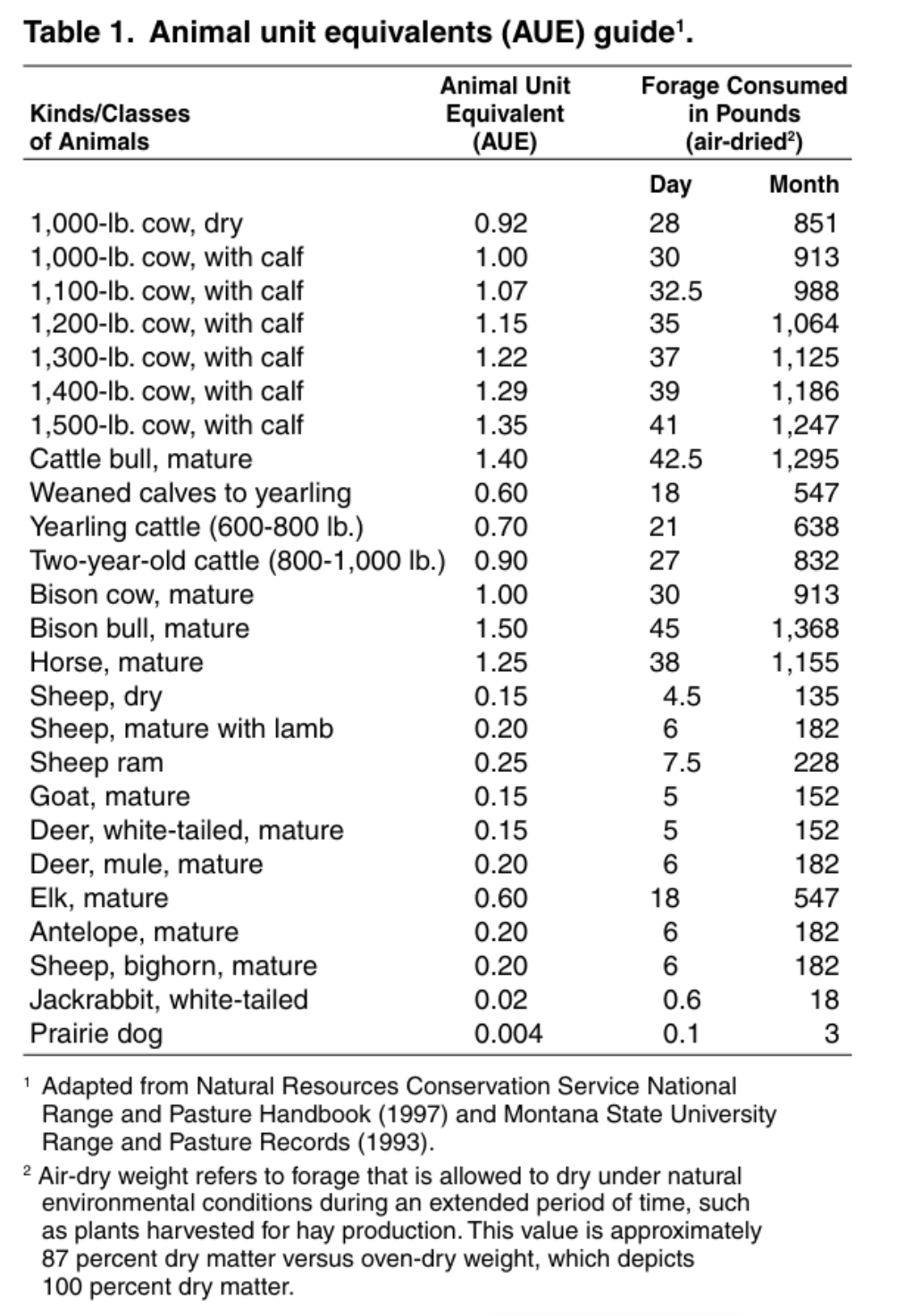
Table: Meehan M., K. Sedivec, J. Printz, F. Brummer. (2018, November). Determining Carrying Capacity and Stocking Rates for Range and Pasture in North Dakota. North Dakota State University Extension. Determining Carrying Capacity and Stocking Rates for Range and Pasture in North Dakota R1810.
Deer, elk, and antelope are some of the most common wildlife viewed across the Rocky Mountain West and can have a substantial effect on livestock and agricultural operations. While not affecting domestic livestock in the same way as predator species, herbivorous wildlife species can have numerous impacts on domestic livestock. Wild herbivore issues concerning feedstuffs can include utilizing fields or other high-use areas, congregating around haystacks or feed lines, or damaging important infrastructure. Wild animals also learn human patterns quite efficiently. Most public lands are open to hunting, while private lands are more selective, usually with less pressure. Wild animals like elk herds that spend their summers on National Forest lands can find a safe(r) haven on private lands during the autumn hunting seasons. This learned behavior and increased grazing pressure just adds to the forage utilization of the area.
One specific example - over a stereotypical year, Rocky Mountain Elk spend the warmer summer months at higher elevations chasing the green-up and then spend the colder winter months concentrated at lower elevations – often times in fields and/or other agriculturally significant areas, feeding in areas with less snow or with easier access. This movement follows a typical western ranching operation – cows grazing higher in the summer and lower, at a higher concentration, in the winter. While wintering herds of elk can contain hundreds of animals in one area, a substantial amount of vegetation can be consumed. This vegetation is subtracted from the total available that can be utilized for domestic livestock. In states where elk and deer cause substantial problems for agricultural operations (examples include Montana, Wyoming, Colorado, Utah) depredation hunting permits can be available on a very regulated basis to allow landowners to remove animals from production areas. Some states also provide funding through an application and approval basis, like through their state department of wildlife, for some financial assistance for resources utilized by large ungulates. Another management model to alleviate large numbers of wild ungulates in developed areas is Wyoming’s use of elk feed grounds across the western portion of the state. This is a specified place where hay is spread and fed, usually by the Game and Fish or a contractor, to a wintering elk herd. While the original feed grounds were established in the early 1900’s (the National Elk Refuge was created in 1912 (Wyoming Game and Fish, 2024)), they have recently become a very debated topic. However, their usage of keeping cattle and elk separate, along with other conservation benefits, should be noted.
Another example of a large herbivore that can cause issues in or around an agricultural operation is the buffalo, or more appropriately called, the bison. Bison can be an interspecies disease reservoir. A bison is a very large animal that can eat a lot in a short amount of time. Bison can be very destructive to livestock infrastructure such as fencelines. And genetically, bison are closely related to cattle and have the potential to create a hybrid offspring if the opportunity arises. Intermountain western states such as Wyoming and Montana have worked hard to keep wild bison and domesticated livestock separate, especially in the Greater Yellowstone Ecosystem, for a variety of reasons. However, Alaska also has a Plains bison problem on the very eastern side of the state. While Wood bison are native to the Interior of Alaska, Plains bison were introduced in 1928 with the hope of increasing future hunting opportunities (Alaska Department of Fish and Game, Bison History). The eastern Interior of Alaska also contains most of the state’s hay, grain, and other crop fields. These bison caused significant damage to agricultural fields in the region. Using state legislative appropriated funds from 1984, the Delta Junction State Bison Range was created in 1985; this includes historic and a continuation of a multitude of habitat and other improvement projects (applying fertilizers, plantings, invasive species management, prescribed burns, mowing, water sites, brush management, etcetera) in an attempt to keep the bison herd on public lands and out of agricultural operations (Alaska Department of Fish and Game, State Bison Range). While the Bison Range’s projects have helped, this is still an ongoing project in the state of Alaska.

Other potentially notable wild herbivorous species can include feral horses, wild pigs, and prairie dogs. Feral horses are large animals, that have the reputation of being overstocked across many western rangelands and very hard on natural ecosystems (including actual plants and riparian systems). Wild pigs are notorious for rooting around and tearing out native vegetation, decreasing overall soil and water health standards, and even have a reputation of being a not-so-strict herbivore-only species. And while (currently) the western United States does not have quite as large of a wild hog problem as the southeastern United States, there are small pocket populations, as well as northern pigs (Canadian feral pigs) trying to spread south and eastern populations trying to spread west. And smaller animals such as prairie dogs and jack rabbits should receive a special shout-out in an article about vegetation usage. As referenced earlier in this paper, one prairie dog is 0.004 of an A.U.E. and a white-tailed jack rabbit is 0.02 A.U.E. (NDSU Extension, 2018), meaning it would take 250 prairie dogs or 50 jack rabbits to eat the same amount as one cow and her dependent calf in a month. But to see just one prairie dog is rare, and a single colony can grow to hundreds of animals. As a burrowing animal, prairie dog colonies consume a lot of vegetation, damage plant roots, provide tripping hazards and leg catches for larger species, and serve as a great host for fleas and other shareable diseases.
As highlighted in this paper, all wildlife species can have an impact on agricultural operations. Large herbivorous species (such as deer, elk, and buffalo) can largely affect the available forage that a domestic livestock enterprise can utilize. As with all concerns, there are ways to minimize this impact; whether it be wildlife-exclusion fencing, allowing wildlife to utilize some fields to avoid others, removing animals, or receiving financial support for wildlife usage. Each operation across the west is unique, as are their challenges and triumphs. And when all information is gathered and resources utilized, a thriving ecosystem can be achieved and sustained.
References
Meehan M., K. Sedivec, J. Printz, F. Brummer. (2018, November). Determining Carrying Capacity and Stocking Rates for Range and Pasture in North Dakota. North Dakota State University Extension. Determining Carrying Capacity and Stocking Rates for Range and Pasture in North Dakota R1810.
Wyoming Game and Fish Department. (2024, March 12). Wyoming Elk Feedgrounds Management Plan. Wyoming Game and Fish Department. Elk Feedgrounds Management Planpdf - Adobe cloud storage.
Alaska Department of Fish and Game. (n.d.). Bison History. Hunting, Delta Bison Hunting Orientation. Alaska Delta Bison Hunter Orientation, Alaska Department of Fish and Game.
Alaska Department of Fish and Game. (n.d.). Delta Junction – State Bison Range Area Overview. Habitat, Conservation Areas, Delta Junction. Delta Junction State Bison Range, Alaska Department of Fish and Game.