Once Bitten, Thrice Shy
by Troy Bishopp
Singer Jim Stafford sang, “I don’t like spiders and snakes”. In 1989, Great White covered “Once Bitten, Twice Shy,” and country singer Brad Paisley’s suggestion to “Check for ticks” became an anthem for anyone who loves the outdoors. The Grass Whisperer now sings, “Love your land, don’t let fear apply. Just check for ticks as the sunset slips by. Check your clothes, your pets and your skin each night. Sip a bourbon because once bitten, thrice shy will make it alright”.
Just because I don’t like ticks, it doesn’t really matter to them, as they seek my tasty blood meal. It didn’t matter to a stealthy, wood tick during a biological monitoring exercise, it couldn’t care less in a wetland building a deer fence or slinking up my shirt after cutting down multi-flora rose bushes. As a guy who regularly walks in grass, it definitely makes you think twice about rolling around in the pasture.
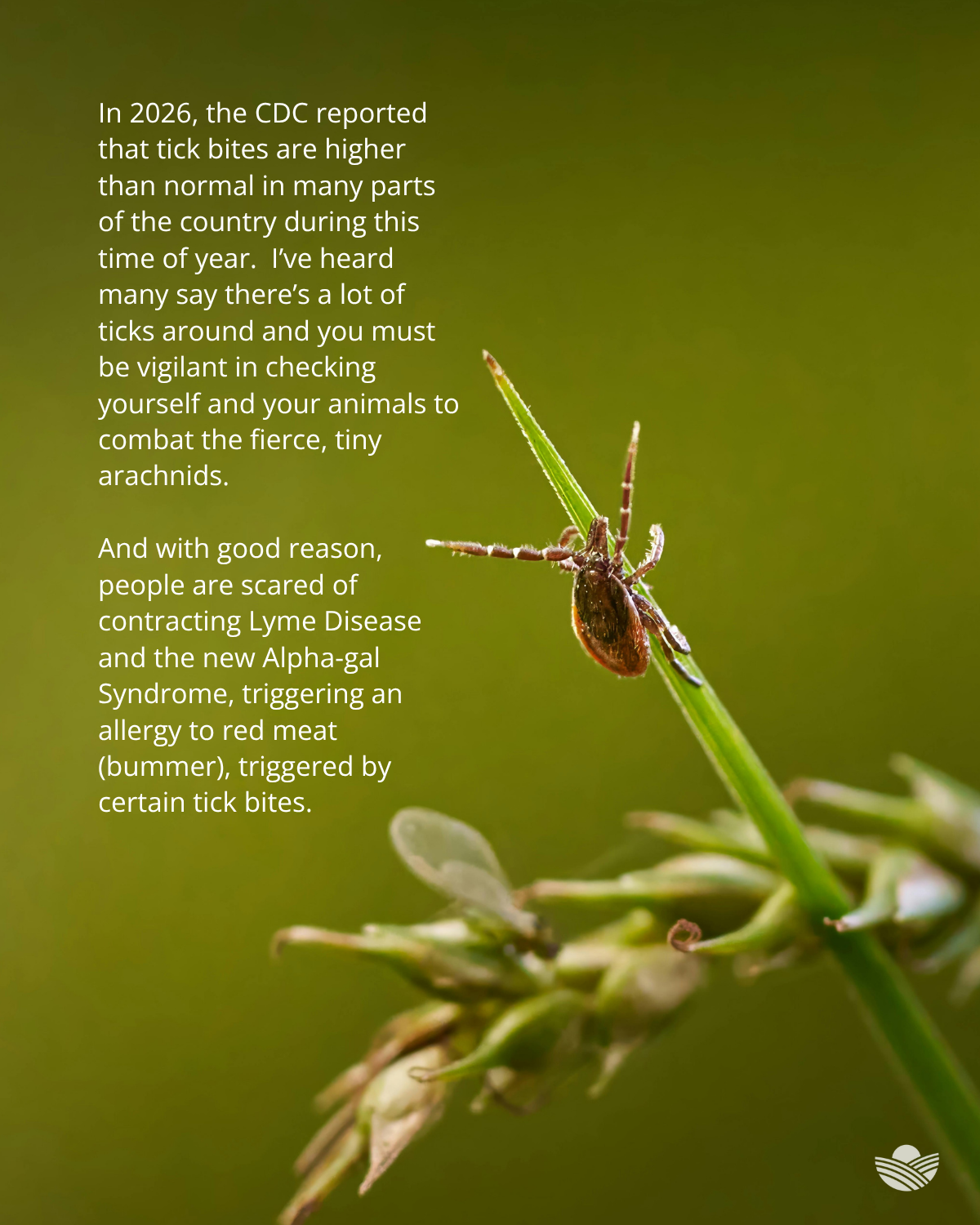
According to the CDC, 31 million people in the United States are bitten by a tick every year. In 2026, the CDC reported that tick bites are higher than normal in many parts of the country during this time of year. I’ve heard many say there’s a lot of ticks around and you must be vigilant in checking yourself and your animals to combat the fierce, tiny arachnids.
And with good reason, people are scared of contracting Lyme Disease and the new Alpha-gal Syndrome, triggering an allergy to red meat (bummer), triggered by certain tick bites. It’s well documented to use Permethrin for clothing & gear, DEET oressential oils for skin and a cornucopia of homemade concoctions to repel the unwanted visitors. Lucky for me, my wife’s cooking with copious amounts of garlic and farmer friends who make lavender spray-on tinctures keep me generally safer than average. Some people’s chemistry isn’t as tasty to ticks ( https://danielcameronmd.com/ticks-risk/ ). Observation and timely action is still a great defense.
As an experienced victim, the unwanted visitor must have appreciated my warm armpit as it hunkered down for the tractor ride back to the barn. Apparently, the little blood thief’s saliva contains anesthetic properties, allowing them to remain undetected for days while feeding on blood. Not paying much attention other than feeling a pimple developing, I kept on doing farm work the next day. By suppertime there was a bit more pain and upon lifting my shirt, the “site” looked like the telltale sign of a bulls-’s-eye pattern. Making it creepier was my wife exclaiming, “I can see little feet moving”. Yikes!!!
To see how a tick attaches itself, check out this horrifying link: https://www.npr.org/sections/goatsandsoda/2018/03/20/594922001/watch-how-a-tick-digs-its-hooks-into-you
What should we do? A question many have probably pondered when faced with this dilemma. Numerous scenarios of detaching the little freeloader flashed into my mind: Subjecting it to Frank’s hot sauce; intense heat from a lighter (not!), gasoline, WD-40, alcohol, hot wax, pliers and even thinking of the Warble fly larvae and pinching it out. Upon consulting Google (isn’t the internet great!) and discovering this might be a case for a health professional, we decided to get checked out at an Urgent Care Center.
I felt more like a baby than a rugged, independent grass farmer as I entered the facility, seeing surgical-masked nurses tending to sick children, injured teenagers, and elderly patients. From within the glass-encased nerve center came a voice that indicated it could be a two-hour wait. Not a great Saturday date night for a tired farm couple. Surprisingly, after the insurance billing procedure, I was able to hit the gurney within an hour. Whether out of luck or fate, I was treated by a feisty and jovial country gal nurse who was also developing a grass farm with her husband and kids.
In the midst of developing a prognosis and approach for freeing my bulls-eyed friend, we collaborated on an emergency room grazing planning session complete with goal setting, paddock allotments and production and financial expectations for filling the freezer. Who knew getting a now named wood tick removed could be so insightful. I did question if this grazing professional information could be used to offset the bill. The query did provide a humorous setting however.
According to my country, health professional, she has seen or treated hundreds of cases of human tick bites, which in my book gives her the field experience I needed to overcome my fear. After a tetanus shot, antibiotic pills, and disinfecting the area, she took her cool set of forceps and, in screwgun-like fashion, backed out my blood-engorged guest from my pit and placed it in a bottle for future Lyme disease testing.
It took about 2 weeks for the redness to go away but the memory will linger for some time. I’ve been told the chances for contracting the many symptoms of Lymes are much less if you dislodge the critter within 24 hours of detection. The test result came back negative, but the experience heightened my awareness. Since that event, I’ve been bitten by poppy-seed-sized nymph ticks and hungry teenager ticks, but through vigilance, no bullseye target.
As a Northeast regional NatGLC grazing manager, we are in a hotbed of tick country, so please stay alert and take a few minutes each day to check yourself, your family, and your animals as best as you can. I realize this subject can be scary but as an adult I choose to remain optimistic. If I subscribe to Brad Paisley’s thinking, checking for ticks can also be construed as fun!