More Than Beaches and Volcanoes
by Gabi Hall
When most people think of Hawaii, they picture volcanoes, black lava rock, surfing, luaus, and vibrant island culture. What many people don't think about is ranching.
But they should.
Some say ranching started in Hawaii. Others know it did. Long before many operations were established on the mainland, Hawaii's paniolo (cowboy) culture was taking shape. Over the course of a week, four NatGLC staff members visited several ranches and learned not only about their livestock and land management but also about the families and histories that have shaped these places for generations. Some ranch stories stretched back to the 1700s.
Because resources are not always readily available, producers have learned to adapt. Whether it was innovative water systems, wind farms for extra energy, or even a ceiling fan powered by an old pulley system, there was no shortage of problem-solving. One lesson echoed throughout the week: "If can, can. If no can, no can."
Although Hawaii is often associated with tropical rain, many areas receive surprisingly little moisture. Yet a series of recent Kona Lows (slow-moving storms) hit in the weeks leading up to our arrival, leaving the landscape covered in tall, lush grass. More than one producer told us how lucky we were to see the islands looking so vibrant. We traveled up the mountains and down to the coast and saw how dramatically the forage changed with elevation. You could enjoy the sunshine by the ocean, then drive into the mountains and find yourself wrapped in clouds. And while we were there, the volcano on the Big Island erupted. Not something you get to experience every day!
What struck me most was how ranchers have adapted and found ways to make it work despite the challenges of island life. One of those challenges is that processing options are limited, and many cattle are shipped or flown to the mainland. We watched the process unfold as two shipping containers were loaded with cattle, and it was a much quicker process than we had expected. We also learned that cattle tend to avoid lava rock (cooled, dried lava), so ranchers can use those areas as natural barriers instead of putting up fences, which saves time and resources.
Today's producers face regulations, labor shortages, and rising costs. Back when many of these ranches were established, there were different challenges, but these families accomplished what many would have thought was impossible. Their stories are a testament to perseverance and a deep connection to the land.
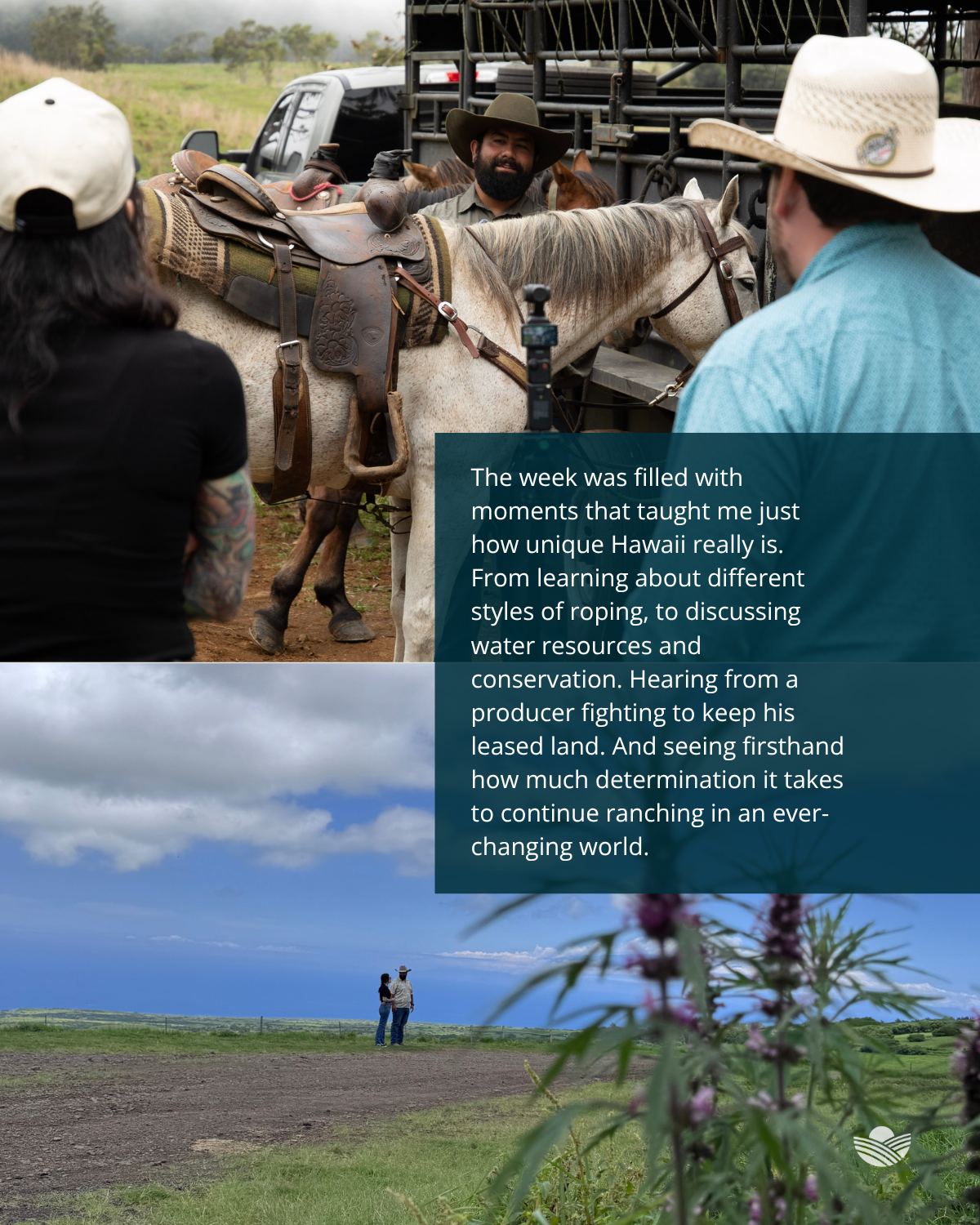
The week was filled with moments that taught me just how unique Hawaii really is. From learning about different styles of roping, to discussing water resources and conservation. Hearing from a producer fighting to keep his leased land and seeing firsthand how much determination it takes to continue ranching in an ever-changing world.
Of course, no trip to Hawaii would be complete without enjoying the local food and traditions. We were given beautiful handmade leis, ate fresh poke daily, and enjoyed some fun, fresh tropical drinks!
A heartfelt thank you to Betty at Hawaii Cattle Producer Cooperative Association and to everyone who welcomed us onto their operations, including Ulupalakua Ranch, Parker Ranch, De Luz Ranch, Lewis Ranch, Ponoholo Ranch, Kealia Ranch, and AJ Ranch.
Thank you for sharing your stories, your history, and your hospitality.
I hope our paths cross again.
Mahalo